Best Pressure Cookers Guide
The Guide · Electric Pressure Cookers for Home Cooks

A 16-in-1 lists more than twice the functions of a 7-in-1 Instant Pot.

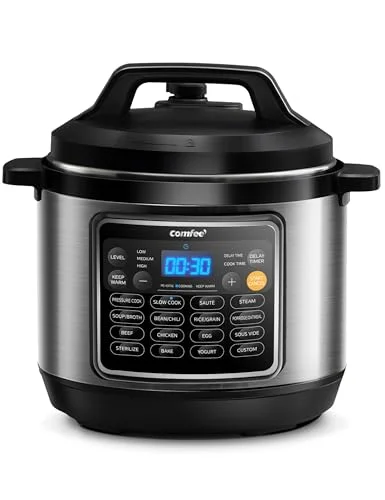
The COMFEE’ on this page is sold as a 16-in-1. Instant Pot calls its Rio Mini a 7-in-1. If that number measured what a cooker can do, the choice would be easy. It doesn’t: every electric pressure cooker is the same machine underneath — a heating plate under a removable pot, a lid that seals and locks, a sensor and a controller — and most functions on the box are presets, a stored time and pressure for soup, beans or poultry that you could set by hand. Cosori sells a 9-in-1 that lists thirteen modes; DUMOS reaches sixteen with twelve presets. What actually separates one cooker from another is capacity, the inner pot, how the steam gets out, and whether it does one genuinely different job, like air frying. We compared published specifications and current Amazon prices for 36 electric pressure cooker listings sold in the US.

By Ilane Tall6 picks · 36 cooker listings comparedResearch-based — no testing lab, no invented scores

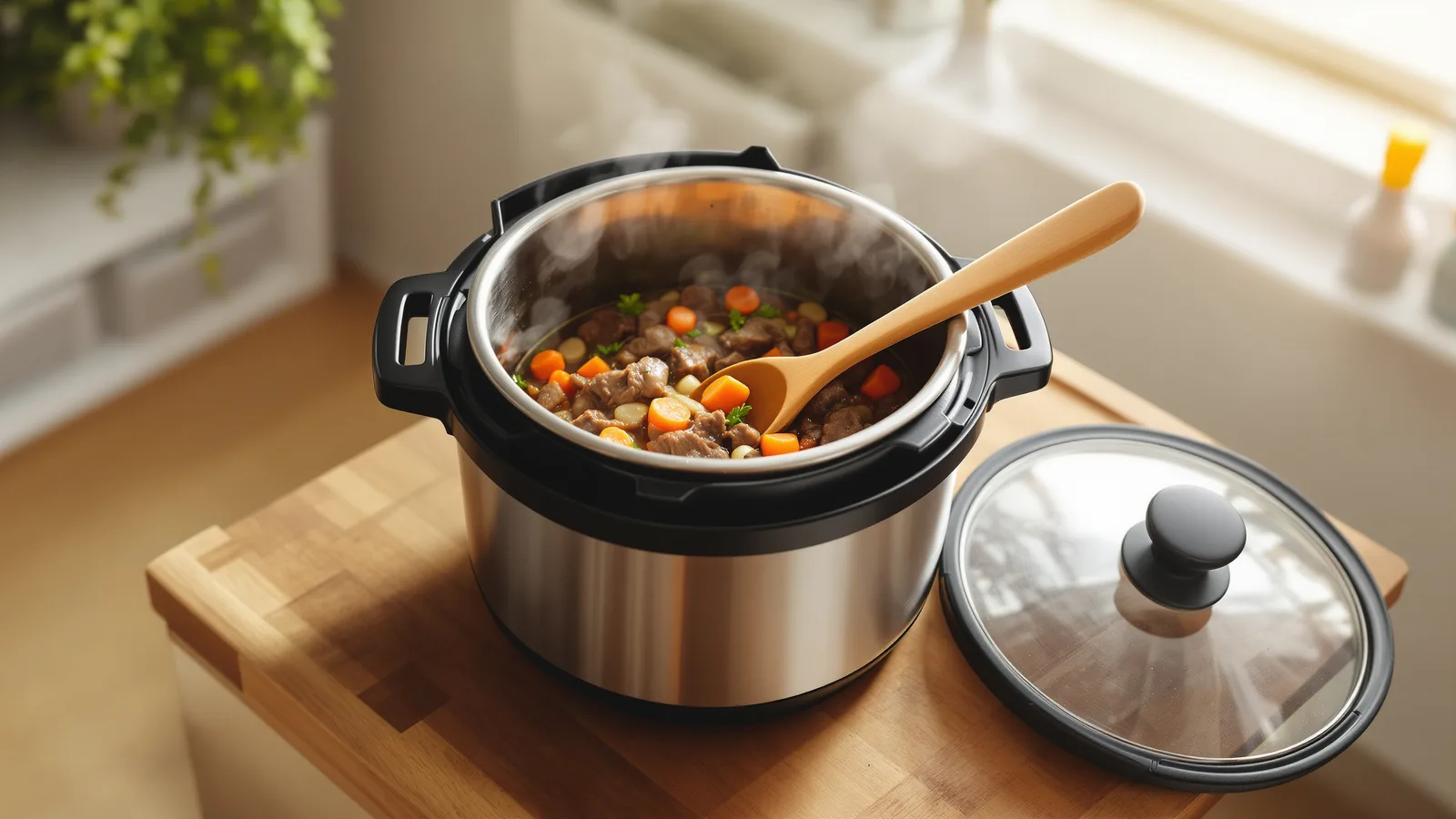
Open electric pressure cooker with beef and carrot stew in its stainless inner pot, the lid resting beside it on a butcher-block counter
The one to buy

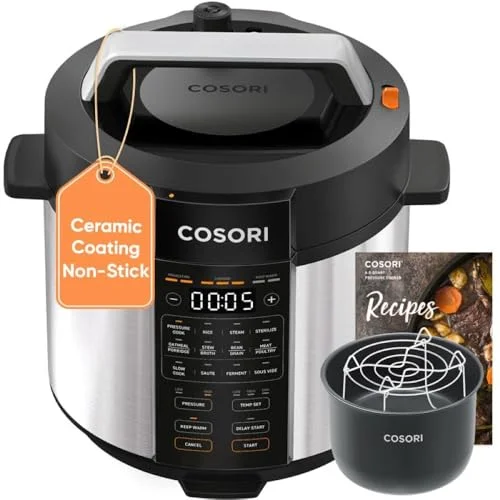
Cosori 6-Quart 9-in-1 Pressure Cooker

The Cosori does everything an everyday electric pressure cooker should, and its listing documents the details that make those jobs easier. It is a 6-quart, 1100-watt machine, the size most American recipes are written for, and its thirteen listed modes run well past the nine on the box. Most are the standard kit; sous vide and ferment are genuine extras at this tier.

What earns it the top spot is the venting and the cleanup. The Seal/Vent button sits away from the steam release valve, and the release is angled 30 degrees backward, so a quick release sends steam toward the back of the machine rather than up past your hand. The lid, inner pot and accessories are listed as dishwasher safe, and the gap between pot and housing has been widened by half an inch, so the pot lifts out and the rim wipes clean more easily.

The honest caveat: the inner pot is ceramic-coated, not bare stainless steel. A coating releases rice and porridge easily, but it wants wooden or silicone utensils, wears with years of scrubbing, and does not brown the base of a stew the way stainless does. If you brown meat before most of what you pressure cook, the stainless-pot CARORI below suits that habit better; to crisp food too, look at the Instant Pot Duo Crisp.

6-quart ceramic-coated pot·1100 watts·13 listed modes·Dishwasher-safe lid and pot
Cosori 6-quart 9-in-1 electric pressure cooker in silver stainless steel
Price
$75.99
Check price on Amazon →

Prices change. We refresh them, but Amazon is the authority.

Before you buy

Four things decide this purchase. The function count is not one of them.

Capacity, after the fill line

Every electric pressure cooker has a maximum fill line, and the standard guidance is no more than two-thirds full, or half for foods that foam and swell, like beans, rice and grains. So a 6-quart pot really cooks about four quarts. That is why makers translate quarts into servings: Instant Pot sizes the 4-quart Rio Mini for up to four, and COMFEE’ rates its 8-quart for 20 cups of cooked rice. Six quarts is the household default and the size most recipes assume; go to eight for big families or batch cooking, and to three or four for one or two people.

Stainless steel or a coated pot

The inner pot is the part you actually cook in, and listings split three ways. Stainless steel, as on the CARORI 9-in-1 and Midea’s 12-in-1, browns meat well, takes a metal spoon and has no coating to wear through, but rice sticks if you skimp on liquid. Ceramic and nonstick coatings, as on the Cosori and the COMFEE’, release food easily but want wooden or silicone tools and wear with years of scrubbing. Fullwill’s dual-pot model hedges with one of each. Several listings never name the material; check the manual before you buy.

How the steam gets out

When cooking ends, pressure comes down one of two ways: natural release, waiting for it to fall on its own, which can take 10 to 30 minutes with a full pot, or quick release, opening a valve so the steam vents in seconds. Makers now design around the nerves quick release causes: Cosori and Midea move the Seal/Vent button away from the valve, the Duo Crisp Ultimate vents from its control panel, and CHEF iQ runs quick, pulse or natural release automatically. Foamy foods such as beans and oatmeal should release naturally, whatever the machine.

The one extra job worth paying for

Pressure cook, slow cook, sauté, steam, rice and yogurt appear on almost every listing we compared, so they decide nothing. What separates machines is a genuinely different job. An air-fry lid, as on the Duo Crisp Ultimate, adds a fan and a heating element for crisping. Sous vide holds water at a low, exact temperature for hours. The CHEF iQ has a built-in scale that tells you how much liquid to add, and Midea’s 10-in-1 pot goes on a stovetop and into an oven up to 500°F. Pick the one extra you would use every week.

Side by side

The six, compared

CookerBest forCapacityInner potStand-outPriceGet it
Cosori 6-Quart Most kitchens 6 qt Ceramic-coated Sous vide, ferment $75.99 Get it
Instant Pot Duo Crisp Ultimate Pressure cook and air fry 6.5 qt Not listed One lid for both jobs $115.96 Get it
Breville Fast Slow Go A premium machine 6 qt Not listed Reduce and risotto settings $249.95 Get it
COMFEE’ 8-Quart Families of six or more 8 qt Nonstick Ten listed safety features $88.34 Get it
CARORI 9-in-1 6-Quart A stainless pot on a budget 6 qt Stainless steel Touchscreen, 12 programs $63.11 Get it
Instant Pot Rio Mini One to four people 4 qt Not listed 8-inch cooking surface $64.99 Get it
The six

Our picks, and who each one is for

01Best overall

Cosori 6-Quart 9-in-1 Electric Pressure Cooker

Best for most kitchens

6 quarts·1100 watts·13 listed modes·Dishwasher-safe lid

The size most recipes assume, an 1100-watt heater, and a mode list that adds sous vide, ferment and sterilize to pressure cook, slow cook, rice, steam and sauté. The details are what put it first. The Seal/Vent button sits away from the steam valve and the release is angled 30 degrees backward, which makes quick release less of an event. The lid, pot and accessories are listed as dishwasher safe, and Cosori lists 12 safety features. The pot is ceramic-coated rather than stainless, the one thing to weigh before you buy.

The one to buy if you want a 6-quart cooker that is easy to vent, easy to clean, and does a little more than the basics.

Cosori 6-quart electric pressure cooker with ceramic-coated pot
Price
$75.99
Check price →
02Best with air fryer

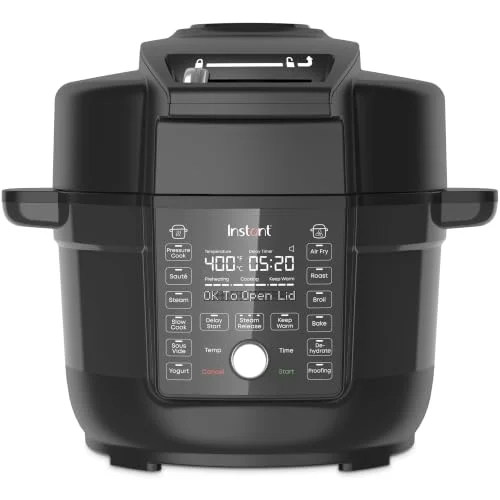
Instant Pot Duo Crisp Ultimate 6.5-Quart Pressure Cooker and Air Fryer

Best for pressure cooking and air frying in one machine

6.5 quarts·13 functions·One lid for both jobs·Venting from the control panel

Many pressure-cooker and air-fryer combos come with two lids, and the spare has to live somewhere. The Ultimate uses a single lid that switches between pressure cooking, air frying and everything else, with no attachments. Its function list is the one on this page that genuinely changes what the machine does: air fry, roast, bake, broil and dehydrate on top of pressure cook, slow cook, steam, sauté, sous vide, yogurt, bread proofing and keep warm. Venting starts from the control panel, and the display says when it is OK to open the lid. The listing does not state the inner pot material or the air-fry capacity.

If you want one appliance on the counter where a pressure cooker and an air fryer would otherwise sit, this is it.

Instant Pot Duo Crisp Ultimate pressure cooker and air fryer with single lid
Price
$115.96
Check price →
03Best premium

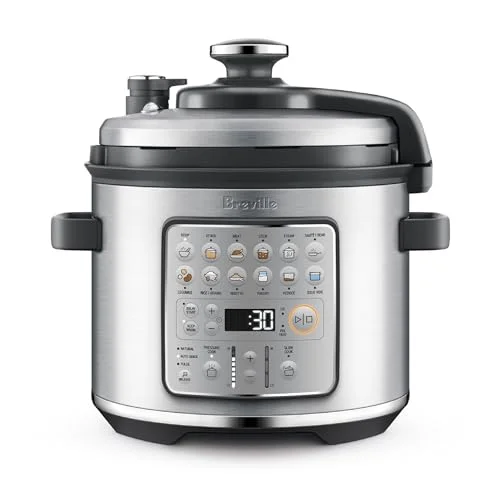
Breville Fast Slow Go 6-Quart Pressure Cooker

Best for a premium machine built around dishes, not a feature count

6 quarts·14 settings·3-way safety system·Brushed stainless steel

The premium machine here, so be clear on what the extra money buys. Not capacity: the pot holds 6 quarts, like the Cosori. It buys a settings list organized around dishes — soup, stock, meat, stew, legumes, rice and grains, risotto, yogurt, reduce and sous vide among them — a brushed stainless body, and a three-way safety system Breville spells out: a pressure release valve, a pressure safety valve and a safety locking pin. The reduce setting is the useful oddity, for simmering a braising liquid down to a sauce. The listing publishes no wattage and does not say what the inner pot is made of.

Buy it for the finish and the reduce setting, not for size: in capacity, a 6-quart is a 6-quart.

Breville Fast Slow Go pressure cooker in brushed stainless steel
Price
$249.95
Check price →
04Best large

COMFEE’ 8-Quart 16-in-1 Electric Pressure Cooker

Best for families of six or more and batch cooking

8 quarts·20 cups cooked rice·16 presets·Nonstick pot

Eight quarts is the size for big households and batch cooking, and COMFEE’ translates it into numbers you can plan with: 20 cups of cooked rice, or meals for six to eight people. The 16 presets cover meat, broth, beans and oatmeal among others, and the listing names ten safety features, including overheat protection, a lid-safety lock and what COMFEE’ calls auto pressure release. The inner pot is nonstick, so it wants gentle utensils. The size has costs: an 8-quart pot needs more liquid and more time to reach pressure than a 6-quart, and more cupboard space. No wattage is listed.

For a family of six, or anyone who cooks once for the whole week, the size is the point. For two people it is just a bigger pot to wash.

COMFEE 8-quart 16-in-1 electric pressure cooker in black
Price
$88.34
Check price →
05Best budget

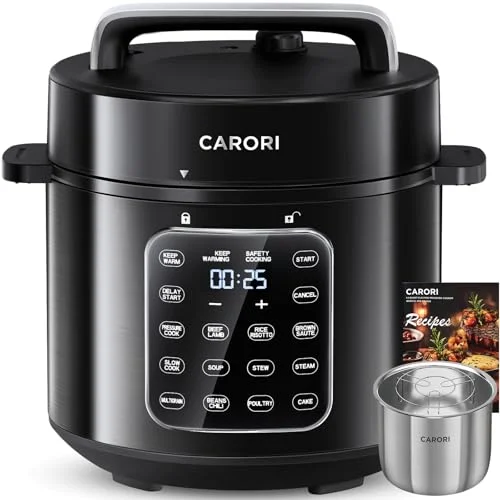
CARORI 9-in-1 6-Quart Electric Pressure Cooker

Best for a stainless steel pot on a budget

6 quarts·Stainless steel inner pot·12 programs·Touchscreen controls

The budget pick is also the only one of the six whose listing commits to a bare stainless steel inner pot, and that is why it is here. CARORI describes the pot as non-coated, scratch-resistant and suited to sautéing in the cooker, which is where stainless beats a coating: it browns meat properly, takes a metal spoon and has nothing to wear through. Around it sit a touchscreen with 12 programs and more than 16 listed safety measures, including a steam release button and pressure limit safeguards. Stainless is less forgiving with rice and porridge, the listing’s copy is muddled in places, and no wattage is given.

A sensible first pressure cooker for anyone who browns before they braise, and a fair way to learn how often you will really use one.

CARORI 9-in-1 6-quart electric pressure cooker with stainless steel inner pot
Price
$63.11
Check price →
06Best small

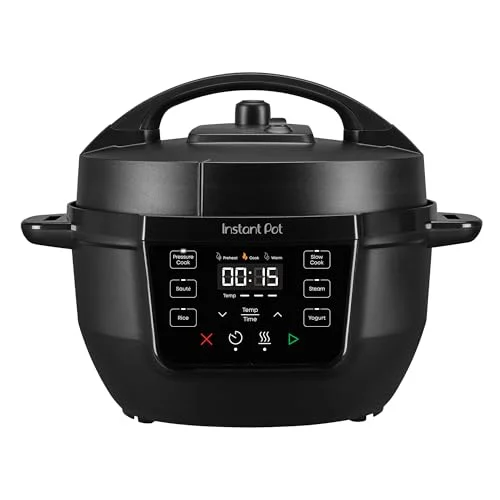
Instant Pot Rio Mini 4-Quart Electric Pressure Cooker

Best for one to four people and small kitchens

4 quarts·Up to 4 servings·7 functions·8-inch pan cooking surface

The 7-in-1 from the headline, and a reminder that seven is plenty: pressure cook, slow cook, sauté, steam, rice, yogurt and keep warm are the jobs most people use. Instant Pot sizes the Rio Mini at four quarts for up to four servings, with the same cooking surface as an 8-inch pan — the figure that matters when you brown two chicken thighs before sealing the lid. It is easy to store. The limits: under the two-thirds fill line, four quarts holds less soup than it sounds, there is no sous vide or sterilize mode, and no wattage or pot material is listed.

The right size for one or two people and a small counter. A family of four will be filling it to the line every night.

Instant Pot Rio Mini 4-quart electric pressure cooker in black
Price
$64.99
Check price →
Our method

How we picked — and what we can’t tell you

What we did

Specs, prices and manufacturer data

We compared published specifications and current Amazon prices for 36 electric pressure cooker listings — about thirty distinct models once color variants are folded together — and kept the cookers whose makers publish something checkable: a capacity, a servings figure, a pot material, a venting design. We treated the in-1 number with suspicion, because makers count presets differently, and weighted capacity, pot, steam release and genuinely distinct jobs such as air frying far above the product copy. Where a model comes in several colors, we link one; Amazon prices each color separately, so check the others.

What we didn’t

We don’t run a testing lab

We do not physically test these cookers, we do not own them, and we do not publish invented scores out of ten. We also have no verified rating data for this category, so this site publishes no ratings of any kind — we would rather show nothing than make something up. The questions that matter most over the years — how long a coating lasts, how a sealing ring holds up after hundreds of cycles — cannot be answered by anybody who has had a cooker for a few weeks. What we can do honestly is read every specification, compare them, and explain how these machines work.

Go deeper

The guides behind the picks

FAQ

Common questions

Is a 16-in-1 pressure cooker better than a 7-in-1?

Not because of the number. Every electric pressure cooker does its core jobs with the same parts: a heating element, a sealed pot and a controller. Most of the extra functions in a higher count are presets for particular foods, such as soup, beans or porridge, that store a time and pressure level you could set by hand. Makers do not even count the same way. Look instead for functions that change what the machine physically does, like air frying or sous vide, and judge capacity, the inner pot and venting.

What size electric pressure cooker do I need?

Six quarts if you are unsure: it is the household default and the size most recipes assume. Mind the fill line. The usual guidance is no more than two-thirds full, or half for beans and grains, so a 6-quart realistically cooks about four quarts. Three or four quarts suits one or two people; Instant Pot sizes its 4-quart Rio Mini for up to four servings. Eight quarts is for big families and batch cooking; COMFEE’ rates its 8-quart for 20 cups of cooked rice. A bigger pot needs more liquid and takes longer to reach pressure.

Does a pressure cooker really cook faster?

Yes, for the right foods, but read the claims carefully. The up-to-70-percent figure on Instant Pot’s Duo Mini and Ninja’s two-times-faster claim are both measured against slow cooking, as their own listings say. A recipe’s time under pressure also leaves out the build-up, often 10 to 15 minutes with a full load, and the release, which can add 10 to 30 more if it is natural. The real win is with foods that normally take hours: dried beans, stock, chuck roast, pork shoulder. For pasta, eggs or quick vegetables, the stove is often just as fast.

Are electric pressure cookers safe?

Modern electric models are designed around the old stovetop fears. The lid locks once pressure builds and will not open until it drops, a float valve shows the state of the pot, and backup valves and sensors guard against overpressure and overheating. Breville, for one, lists three separate safety components, and several budget listings add dry-boil monitoring. Your part is simple: stay under the fill line, keep the sealing ring and valve clean, and never force the lid. In the US, look for a UL or ETL mark, which shows an independent lab has checked the unit against the relevant safety standard.

Is an electric pressure cooker as good as a stovetop one?

Different, rather than better or worse. Stovetop cookers usually run at around 15 psi, while electric models generally work lower — CARORI’s 8-quart 12-in-1 lists up to 70 kPa, roughly 10 psi — so electric recipes take a little longer. A stovetop pot sears over a full burner and has no electronics to fail; Presto’s 6-quart aluminum model uses a pressure regulator and a cover lock indicator. The electric machine wins on convenience: it regulates itself, keeps food warm, starts on a timer and can be left alone. For most households, that decides it.

Can I use an electric pressure cooker for canning?

Not for pressure canning low-acid foods, under current US guidance. Several listings we compared advertise a canning preset, but the National Center for Home Food Preservation, the main US source for USDA-based home canning methods, does not support pressure canning in electric multi-cookers: their processing temperatures have not been validated, and under-processed jars of vegetables, meat or beans carry a risk of botulism. A preset on a menu is not a validated process. For low-acid foods, use a dedicated pressure canner and current USDA instructions. This is general food-safety information, not a substitute for the official guidance.

Is a pressure cooker with an air fryer lid worth it?

Yes, if counter space is the problem and you would use both. A combo puts a fan and a heating element in a lid over the same pot, so you can pressure cook a chicken and then crisp the skin without moving it. The trade-offs are bulk and batch size: an air-fry lid is heavier than a pressure lid, and a deep round pot crisps one layer at a time, so a basket air fryer handles bigger batches of fries or wings. Instant Pot’s Duo Crisp Ultimate at least spares you storing a second lid. If you already own an air fryer, buy a plain pressure cooker.